A pallet can look wrapped and still fail in transit. Film applied too high, too loosely, or without tying the load to the pallet leaves room for cartons to shift, corners to crush, and product to arrive damaged. Knowing how to wrap pallets manually is not just a shipping task. It is a repeatable process that affects worker strain, film use, load stability, and customer service.
Manual wrapping is often treated as the last step before a shipment leaves the building. That is exactly why it needs a standard. When every operator uses a different starting point, amount of tension, or number of passes, load quality becomes unpredictable. A practical method gives employees clear steps while reducing the repeated bending, wrist turns, and tight gripping that make wrapping physically demanding.
Start With a Pallet That Can Be Wrapped Securely
Stretch film cannot correct a poorly built load. Before picking up the dispenser, inspect the pallet, product stack, and surrounding work area. A damaged pallet, leaning cartons, or protruding product can defeat even a careful wrap job.
Use a pallet that is dry, structurally sound, and sized appropriately for the load. Cartons should sit squarely on the deck with heavier items at the bottom and lighter items on top. Keep the footprint as even as possible. If cases overhang the pallet, they are more vulnerable to impact from forklifts, dock equipment, and adjacent freight.
Correct any obvious instability before wrapping. Restack shifted cartons, replace broken boards, and use corner protection when sharp edges could cut the film or when stacked boxes need additional support. For unusually tall, light, or irregular loads, film alone may not be enough. Bands, corrugated corner boards, top caps, or a different pallet configuration may be necessary.
Clear the area around the pallet as well. The operator needs room to walk a full circle without stepping over loose material, bumping into staged freight, or backing toward equipment. A clean path supports both consistent film application and safer body movement.
Choose Film and Equipment for the Load
The right film depends on the load weight, shape, surface, travel distance, and handling conditions. A heavy load with rough edges needs more puncture resistance than a stable, uniform stack of cartons. A load moving through multiple transfer points may need more containment force than a pallet traveling directly to a nearby customer.
Do not try to solve every problem by using more film. Excessive layers add cost, slow the operator, and can hide a load-building issue. On the other hand, thin or damaged film applied with too little tension can allow a load to move before it reaches the truck.
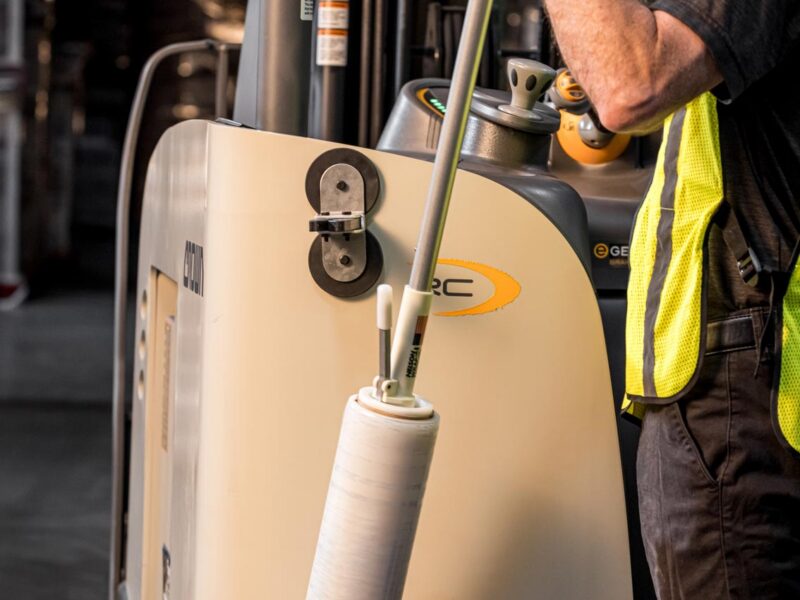
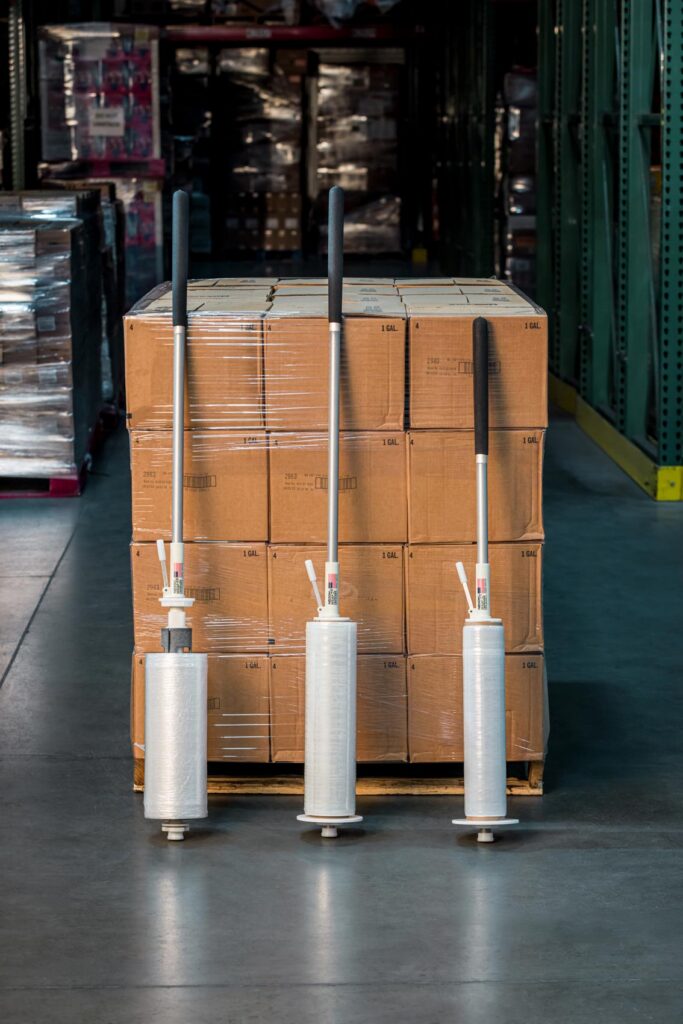
A purpose-built manual dispenser helps control film tension and keeps the roll manageable throughout the wrap. It also reduces the need to grip a bare roll tightly or make repeated awkward wrist movements. For operations with frequent manual wrapping, an ergonomic tool such as a Nelson Wrap Dispenser can help standardize the process while reducing the low-level bending that occurs at the base of every pallet.
Film width matters, too. Wider film covers more vertical area per pass, while narrower film can be useful on smaller loads or where precise application is needed. Whatever film is used, inspect the roll before starting. Replace rolls with crushed edges, tears, or contamination that can cause breaks during application.
How to Wrap Pallets Manually, Step by Step
Position the pallet so the operator can move around it safely. Place the film roll in the dispenser and pull out enough material to begin without yanking the film abruptly. The objective is to create a secure connection between the load and the pallet, then apply consistent containment from bottom to top.
Attach the Film at the Base
Begin at a lower corner of the load. Secure the film tail by pressing it against a carton edge, tucking it through a stable opening where appropriate, or holding it in place during the first pass. Avoid tying film around a pallet board in a way that will make the load difficult to handle later.
Make several wraps around the bottom portion of the load. These first passes should capture both the lower cartons and the pallet itself. This is the anchor that keeps the load from sliding independently of the pallet during acceleration, braking, and forklift movement.
Apply enough tension to remove slack, but do not pull so hard that cartons bow inward, corners collapse, or the film breaks. The correct amount of tension depends on the film and the load. Operators should feel consistent resistance while the film remains intact and the stack stays square.
Work Upward With Consistent Overlap
After building the base, walk around the pallet in a steady direction and gradually move the film upward. Overlap each pass by roughly half the width of the film. That overlap prevents open gaps and distributes containment force across the load rather than concentrating it on a few narrow bands.
Keep the dispenser at a comfortable working height when possible. The film path should rise gradually rather than jumping from the base directly to the middle of the pallet. A smooth spiral pattern gives the load better support and makes it easier for a supervisor to inspect whether the wrap is complete.
Maintain a controlled pace. Moving too quickly often creates loose passes, inconsistent overlap, and missed corners. Moving excessively slowly can waste labor without increasing stability. The right pace is the one that lets the operator maintain tension, watch the film edge, and keep safe footing throughout the rotation.
Reinforce the Top and Return Downward
When the wrap reaches the upper portion of the load, make two or more complete passes around the top. These passes help hold upper cartons together, especially on loads that may be bumped, tilted slightly, or staged beneath other freight.
For most palletized loads, spiral the film back down toward the base after reinforcing the top. The downward pass adds containment through the middle of the stack and gives the bottom another layer of support. It also avoids a common weakness: wrapping only upward and leaving the load with limited reinforcement between the top and the pallet.
Use extra reinforcement selectively. An additional band around the middle can help stabilize tall cartons. More film around a damaged box usually will not solve the problem, however. Replace or restack compromised product before it becomes a shipping claim.
Finish the Tail So It Stays Put
End the wrap near the bottom or on a stable section of the load. Tear or cut the film cleanly and press the tail firmly against the wrapped surface. Do not leave a long loose tail that can snag on forklift components, conveyor equipment, or other pallets.
Step back and inspect the finished load from more than one side. The film should be snug, evenly overlapped, and connected to the pallet. The load should remain square without visible leaning, open vertical gaps, loose tails, or exposed areas where cartons can shift.
Protect the Operator While Protecting the Load
The traditional manual-wrapping motion asks employees to bend near ankle height, reach across the load, grip a film roll tightly, and circle the pallet repeatedly. Done dozens of times per shift, those movements can create unnecessary strain in the back, shoulders, hands, and wrists.
Train operators to keep the walking path clear, use stable footing, and avoid twisting at the waist while pulling film. Instead of reaching far across a corner, move around the pallet and keep the work in front of the body. When wrapping low sections, use equipment that allows the film to be applied without repeated deep bending whenever possible.
A dispenser should be maintained as seriously as any other shipping tool. Check handles, brakes, film holders, and moving parts regularly. Equipment that binds, slips, or makes film tension inconsistent can cause both poor wraps and compensating body movements that increase strain.
Avoid the Manual Wrapping Mistakes That Create Rework
The most common error is wrapping only the cartons and failing to capture the pallet. That may leave a neat-looking load that can slide off its base when a forklift turns or a truck brakes. Another frequent issue is using minimal film at the bottom while adding excessive layers at the top. Load stability starts at the base.
Inconsistent overlap is another source of preventable failure. If the operator leaves wide uncovered spaces between passes, the film cannot distribute force effectively. Too much overlap, however, increases film consumption with limited benefit on a stable load. A defined overlap standard helps supervisors coach for quality rather than relying on appearance alone.
Watch for film that is stretched beyond its useful range. Overstretched film may look tight during wrapping but can lose containment or tear when the load is handled. Conversely, film applied with little tension allows cartons to settle and shift. The goal is controlled, repeatable tension, not simply pulling as hard as possible.
Manual wrapping improves fastest when the process is observable. Have supervisors periodically inspect finished pallets, note where film breaks or loads shift, and ask operators where the process requires awkward reaching or extra passes. Those observations can reveal whether the real issue is film selection, load construction, operator technique, or inadequate equipment.
A secure pallet is built before the trailer door closes. Give employees a clear wrapping standard, the room to move safely, and tools that support consistent tension. That small discipline at the shipping station can prevent damaged freight, wasted film, and a great deal of avoidable rework down the line.