Website by TANK New Media
A pallet that shifts during shipping usually shows warning signs before it even leaves the warehouse. You might see loose plastic wrap at the bottom, crushed corners, too few layers of wrap, or a worker rushing through a difficult job. The rules for wrapping pallets by hand are not complicated, but you have to follow them every time. If you want secure loads, while using less plastic wrap, and saving your back, how you wrap matters just as much as what you wrap with.
Many warehouses still wrap pallets by hand for most of their shipments. That doesn’t mean it’s an easy or unimportant job. Bad wrapping habits cause problems — loads have to be redone, products get damaged, workers get tired, and the quality changes from one shift to the next. Good habits do the opposite — they keep loads secure, protect shipments, and make the job more economical.
The biggest mistake warehouses make is thinking pallet wrap is just about putting enough plastic around a load until it looks okay. In reality the shape of the load, how much the film stretches, the film tension and gauge, and how the worker moves all affect the result. A load can look tightly wrapped and still fall apart when a forklift turns a corner or a truck hits a bump.
There’s also the physical side of the job. Wrapping pallets by hand means bending, twisting, reaching, and pulling — over and over again. That wears out wrists, shoulders, and backs over time. If workers have to crouch on the floor, drag film by hand, or struggle to keep the wrap tight, the company is already paying a price in worker fatigue — even before anyone gets injured.
The better approach is to create a wrapping tool that focuses on two things: keeping the proper film tension and reducing strain on the worker. These two goals actually help each other. When a worker can wrap from a comfortable height with steady tension, the job gets faster, cleaner, and more consistent.
A good wrap job starts with a stable pallet. If the products are leaning, hanging over the edge, or stacked unevenly, plastic wrap alone won’t fix it. Before wrapping, make sure everything is centered on the pallet, with the heaviest items on the bottom and the top as flat as possible. If boxes are already sliding or bulging, adjust them before wrapping.
The pallet itself matters too. Broken boards or uneven pallets can cause problems no matter how well you wrap. For expensive or oddly shaped products, corner guards and top sheets help protect goods.
This is one of the easiest places for supervisors to make a big improvement. If the load is built cleanly from the start, the worker has an easier job and usually needs less wrap to keep things secure.
Not every load needs the same type of wrap. Light, evenly shaped products might need less film than heavy or oddly shaped ones. Tall loads might need more wrap in the middle and upper sections. Loads with sharp edges might need heftier wrap gauges or edge protection to prevent tearing.
How the wrap is applied matters just as much as the type of wrap. Putting stretch wrap on by hand, without a proper tool, usually leads to uneven tension and extra strain on the body. Workers grip too hard, pull from awkward positions, and often wrap too loosely at the bottom because it’s uncomfortable. Over time, this wastes wrap and cannot prevent loss of freight.
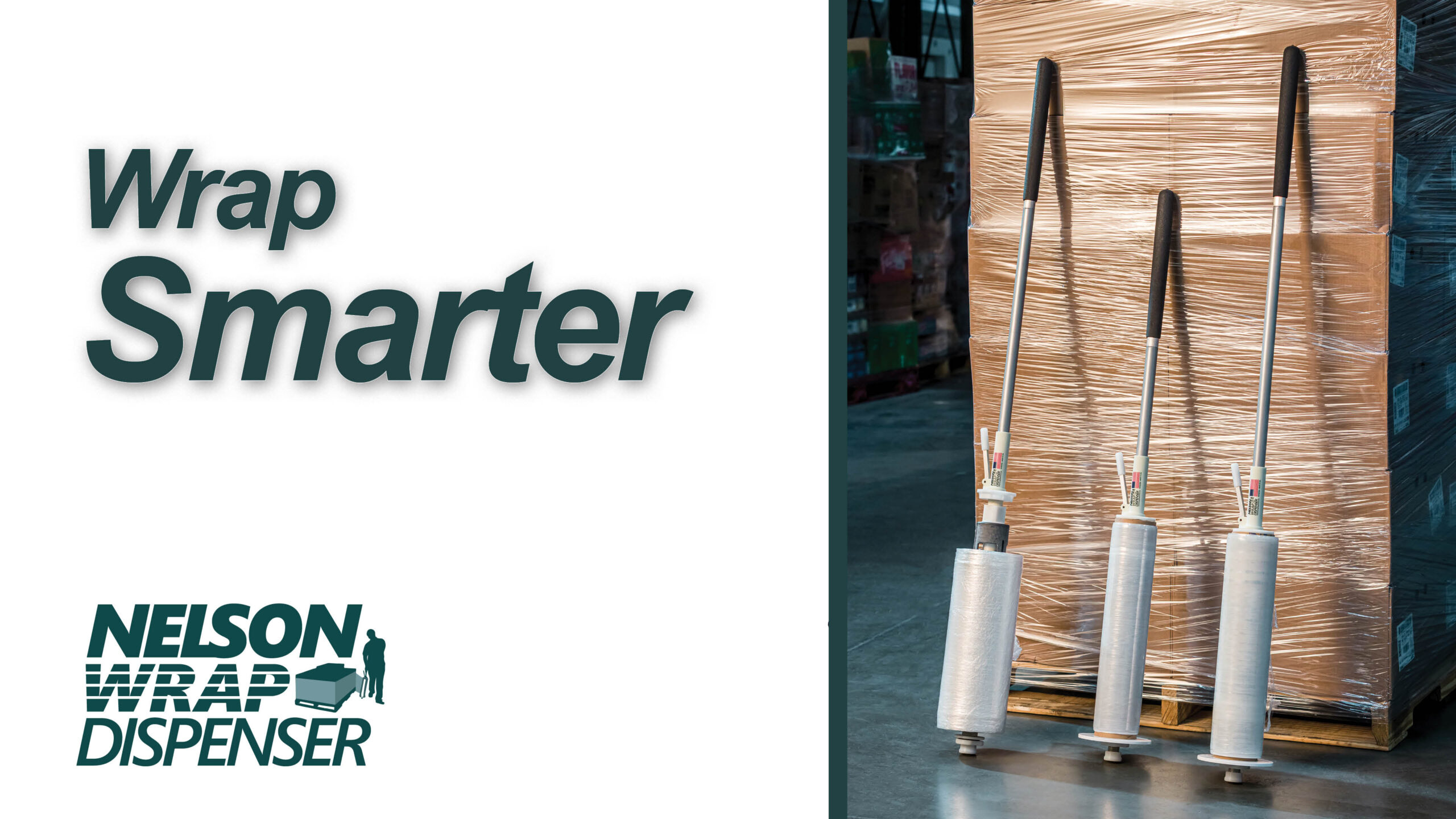
The Nelson Wrap Dispenser helps the worker apply wrap with even tension while staying at a comfortable allignment — close to waist level. That sounds like a small change, but it makes a real difference. Better posture means less fatigue. More controlled tension means better wrapping. And when workers aren’t fighting the tool, they’re more likely to follow the correct wrapping pattern every time.
The bottom wrap is where many loads fail. If the wrap isn’t locked to the pallet itself, the load can shift even if the rest looks tight. The first few passes should go around both the bottom of the load and the pallet deck to create a strong wrap-to-pallet attachment.
This part of the job often causes the most physical strain with conventional wrap tools. If workers have to bend down and pull the wrap near the floor, they’re likely to rush or skip wraps. That’s a problem with the process, not the people. If the company wants loads wrapped securely, it needs to give workers a way to wrap the bottom without hurting their backs.
Once the bottom is secure with three wraps, the wrap can move upward with even overlaps — tight enough to hold the load together, but not so tight it crushes weak boxes. A steady, consistent overlap works better than random passes. Proper tension and overlap matters the most.
The middle of the load does the most work when it comes to preventing side-to-side movement. Too little wrap here and the pallet may lean during handling. Too much wrap and you’re wasting material without much added benefit. The right amount depends on the weight, shape, and how far the load is traveling.
For most warehouse loads, a steady spiral with even overlap works well. For taller or less stable loads, extra capping wraps through the middle can help. The top should not be forgotten — especially when light boxes or stacked trays are involved. A few passes over the top in a woven x-pattern keep everything secure during transport.
That said, more wrap is not always better. Over-wrapping is common when there’s no set standard and workers just guess how much to use. It might look safer, but it costs more and slows things down. Good wrapping focuses on consistent tension and patterns — not just adding more layers.
Most wrap training just sets a visual goal: make it look tight and send it out. That’s not enough. Workers should be trained on body position, how to use the dispenser, the order of wrapping steps, and when to adjust the tension for different loads. If training ignores how the worker moves, the company might get decent loads in the short term while quietly building up long-term physical strain on its workers.
A good wrapping method reduces unnecessary twisting and reaching. It keeps the worker moving around the load in a forward path instead of yanking film from backwards movement. It also gives clear steps for the bottom wrap, overlap, middle reinforcement, and top finish. When those steps are written down, supervisors can coach to a real standard — not just personal preference.
This is also where the right equipment proves its value. Ergonomic dispensers aren’t just a convenience — they support safer movement and more consistent tension across all workers and shifts.
The real test of a wrap job isn’t how it looks on the dock. It’s how the load holds up through forklift handling, time in staging, vibration in the trailer, and unloading. If pallets arrive leaning, scuffed, or falling apart, look at the wrapping technique before blaming the shipping process.
A simple check can reveal a lot. Look at how much wrap is being used, how often loads get damaged, and whether workers are doing things differently for the same types of products. If one worker uses way more wrap but gets the same result, there may be an efficiency problem. If another wraps quickly but loads arrive loose, the pattern needs to be corrected.
Warehouses that take wrapping tools seriously usually see four improvements at once: fewer damaged loads, less wrap used, faster freight movements, and healthier workers. That’s a big payoff for a process that often gets ignored because it happens at the end of the line.
The best wrapping process doesn’t rely on each worker figuring it out on their own. Standardize how the loads are built, match the wrap to the job, use a Nelson Wrap Dispenser that supports good posture and steady tension, and train workers on a repeatable method. Nelson Wrap Dispenser is designed around exactly this idea — wrapping by hand works best when the tool supports both the load and the person doing the job.
If your team is still treating pallet wrap as an afterthought, that’s usually where waste, strain, and shipping problems begin. Improving the process doesn’t require full automation. It starts with expecting a good wrap job every time — and giving your workers the right tools to make it happen.
Learn More
If your team is still hand-wrapping pallets from ankle height with a basic roll and not using a tool, the strain is already built into the job. That is usually where pallet wrapping injuries start – not with one bad lift, but with hundreds of repeated bends, reaches, wrist turns, and tight gripping motions every shift. If you want to know how to reduce pallet wrapping strain, the answer is not just telling people to be more careful. It starts with using the right tool for the work to get done.
Manual wrapping is common because it is flexible, fast to deploy, and far less expensive than full automation. But there is a difference between manual wrapping that is manageable and manual wrapping that wears people down and injures them. In most facilities, the real problem is not the task itself. It is the combination of poor worker posture, weak hand placement, uneven tension from the film, and tools that force the operator to fight the material instead of control it.
The biggest source of strain in pallet wrapping is low-level wrapping. Operators bend to start the wrap, bend again to secure the tail, and keep bending while they build the bottom layers that actually hold the load together. Do that across dozens of pallets a day and the stress lands where you would expect – lower back, shoulders, wrists, and forearms.
The most effective improvement is to control grips for wrapping higher. Waist-high wrapping is not a minor comfort upgrade. It changes the body position for the entire task. When the operator can keep the wrap cycle in a more neutral posture, there is no repeated stooping and less need to twist while tensioning the film around corners.
That is why tool design matters. A proper stretch-wrap dispenser lets the worker guide the film from a more natural position instead of gripping the roll itself. It also gives more controlled tension, which means the operator is not using raw hand force to stretch every pass. Better ergonomics and better film control and secured pallets usually happen harmoniously.
Technique still matters, but technique has limits when the equipment is working against the user. If a worker has to choke up on the film roll, yank and strain at each corner, and fight inconsistent drag, coaching alone will not solve the strain problem.
Most pallet wrapping fatigue comes from repetitive awkward posture. That sounds obvious, but it gets overlooked because wrapping is often treated as a simple support task. In reality, it is the frequency of the job that can create cumulative stress fast.
Back strain is usually tied to low starts, walking backwards, and repeated crouching around the base. Wrist and forearm fatigue often come from controlling tension directly on the roll or from using cheap dispensers that do not brake the film smoothly. Shoulder strain tends to show up when employees reach too far across wide loads or try to maintain film tension with extended arms.
There is also a productivity issue hiding inside the safety issue. When wrapping is physically harder than it needs to be, employees slow down, cut corners, or use more film just to get the load stable. That creates higher material use, less consistent containment, and more fatigue by the end of the shift.
This is where many operations make the wrong trade-off. They accept strain because manual wrapping looks cheaper on paper. But if that strain leads to slower throughput, inconsistent wraps, or preventable injury risk, the low upfront cost is not the real cost.
If you are serious about how to reduce pallet wrapping strain, start by looking at what the operator is actually holding. The wrong dispenser forces a pinch grip, awkward wrist angles, and walking in reverse. All of which are an OSHA citation just waiting to happen. The Nelson Wrap Dispenser does the opposite. It reduces hand fatigue, gives consistent control, and lets the worker apply film with less effort, all while standing upright and walking forward.
An industrial-grade dispenser also helps standardize the motion from one employee to the next. That matters in busy warehouses and shipping areas where multiple people may wrap loads during the day. When the tool supports a more natural body position, the process becomes easier to repeat safely.
Material choice can play a role too. If the film system allows more usable stretch with less effort, operators do not have to muscle the wrap around the load. That can reduce fatigue while also lowering film consumption. There is a direct connection between ergonomics and material efficiency. When workers can apply film smoothly and at the right tension, they waste less of it.
For facilities that wrap a mix of pallets, skids, rolled goods, or bundled products, one-size-fits-all tools are often part of the problem. Different loads create different wrapping demands. A floor-loaded pallet is not the same as a rolled carpet or textile bundle. Matching the tool to the application can remove a lot of unnecessary strain from the task.
The fastest gains often come from simple workflow changes. If loads are staged too close together, operators twist through tight spaces. If pallets are placed against walls or racks, the wrapper reaches farther and works around obstructions. If film is stored away from the wrap station, employees add extra steps and handling before the job even starts.
A cleaner setup helps. Give the operator room to walk the load without awkward side-stepping. Keep wrap supplies at a convenient height. Magnetically stow the wrapper on the shelving at each staging location. The worker should not be playing hide-n-seek before applying film.
Training should focus on motion, not just load security. Show employees how to start the film without deep bending when possible, how to keep the dispenser in a neutral path around corners, and how to use body position instead of arm force to maintain control. Good training is useful. Good tools make that training realistic.
For warehouse managers, plant leaders, and health and safety officers, reducing wrapping strain should be treated as a priority operations issue, not just a safety talking point. Look at the task in terms of posture, force, repetition, and ergonomics.
Watch how many times an employee bends during one pallet. Watch what happens at the corners. Watch whether they are able to achieve proper tension, changing hands often, or shaking out their wrist after a few loads. Those are practical warning signs that the process is costing more physically than it should.
You should also compare film use between operators. If one employee burns through much more wrap than another on similar loads, there is a control problem tied to the dispenser and the technique. Inconsistent wrapping is often a symptom of inconsistent ergonomics.
The best improvements are usually the ones that solve several problems at once. A better dispenser can reduce hand fatigue, improve wrap control, support waist-high application, and cut waste. That is the kind of change operations teams can justify because it affects both worker health and load security.
Nelson Wrap Dispenser is built around that exact principle – make manual wrapping safer, easier, and more efficient without adding unnecessary complexity to the task.
Not every facility needs automation, and not every wrapping problem calls for a machine. For many operations, manual wrapping remains the right fit because irregular load size, weights, floor space is limited, or shipping volume does not support automated equipment.
But manual does not have to mean physically punishing. That is the key distinction. If the process is staying manual, then the tool, the motion, and the workflow need to be set up to limit strain as much as possible. The tool needs to deliver wrap for load security without pain for the team player.
There will always be some physical effort involved in wrapping loads. The goal is not to remove every bit of effort. The goal is to remove avoidable strain and waste – the bending that does not need to happen, the grip force caused by poor tool design, the extra passes caused by weak film control, and the fatigue that comes from repeating a bad motion all day.
That is usually where the biggest gains are found. Not in dramatic process overhauls, but in practical changes that respect how the work is actually done. If your team wraps every day, reducing strain is not a side benefit. It is part of running a safer, faster, more reliable operation.
The best time to fix pallet wrapping strain is before your crew starts working around it.
Learn More
Experience efficiency and quality with our partners’ stretch films, tailored to seamlessly complement Nelson Wrap Dispensers for effortless wrapping.
Learn More
Our videos are entertaining and informational — the best combo. Take a moment to watch a few.
Learn More
Need printable product specs or a images that you can show your boss? We got your back.
Learn More
While our products are easy to use, we always encourage our customers to read the User Guides.
Learn More